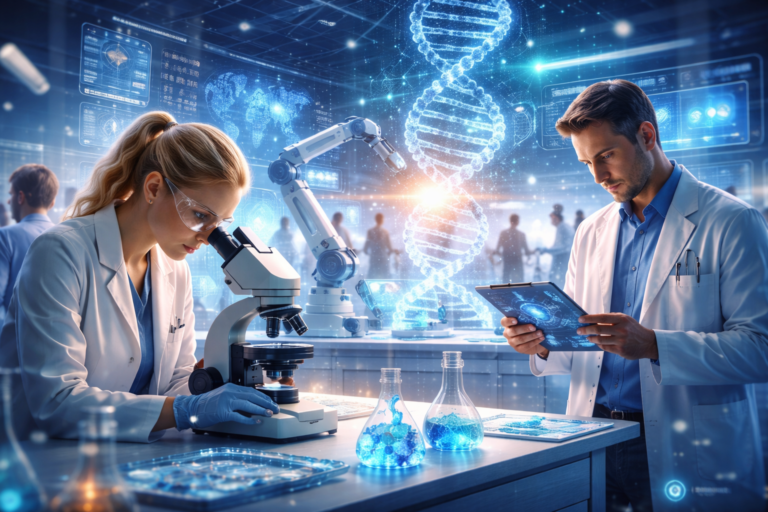
The medical laboratory, once seen as a quiet, back-end service, has become the epicenter of modern medicine. Generating up to 70% of the objective data used for diagnosis and treatment decisions, clinical laboratories are leveraging cutting-edge science and technology to deliver faster, more accurate, and increasingly personalized healthcare. This is a field undergoing a profound technological revolution.
1. Automation and Robotics: The Era of High Throughput
Modern labs are defined by Total Laboratory Automation (TLA), where robotic systems handle nearly every step of the testing process. This is driven by the need for speed, precision, and efficiency in handling millions of samples annually.
- Sample Handling: Robots manage the collection, barcoding, sorting, and centrifugation of samples, minimizing human error and risk of contamination.
- Integrated Analyzers: Complex, high-speed machines automatically draw samples and perform multiple tests simultaneously (chemistry, hematology, immunology), processing thousands of results per hour.
- Result Reproducibility: By standardizing every movement and measurement, automation ensures the reproducibility of results, a critical factor in clinical decision-making.
2. The Genomic Frontier: Next-Generation Sequencing (NGS)
One of the most transformative scientific breakthroughs in the lab is the widespread adoption of Next-Generation Sequencing (NGS).
- Personalized Medicine: NGS allows scientists to rapidly sequence and analyze large sections of an individual’s DNA and RNA. This enables precision medicine, where treatment plans—especially for cancer and chronic diseases—are tailored to a patient’s unique genetic makeup.
- Infectious Disease Diagnostics: NGS can quickly identify the entire genome of a pathogen (like bacteria or viruses), allowing health officials to accurately track outbreaks, determine antibiotic resistance, and develop targeted vaccines.
- Liquid Biopsies: This non-invasive technology analyzes circulating tumor DNA (ctDNA) found in the blood. Liquid biopsies allow clinicians to monitor a cancer patient’s status, detect relapse early, and assess treatment effectiveness without painful surgical biopsies.
3. Artificial Intelligence (AI) and Digital Pathology
The sheer volume of data produced by automated analyzers and scanners is now being managed and analyzed by sophisticated AI and machine learning (ML) algorithms.
- Digital Pathology: High-resolution scanners convert traditional glass slides (tissue samples) into digital images. AI algorithms can then rapidly scan these images, flagging subtle abnormalities or cancerous cells with greater speed and sometimes better consistency than the human eye. This also facilitates telepathology, allowing remote experts to consult instantly.
- Predictive Diagnostics: AI analyzes vast datasets (including patient history, imaging, and lab results) to identify patterns and predict future health risks, enabling doctors to intervene preventively.
4. Point-of-Care Testing (POCT) and Decentralization
The lab is physically moving closer to the patient, increasing accessibility and speed.
- POCT Devices: These are small, portable, user-friendly devices used at the patient’s bedside, in clinics, or even at home. They provide immediate results for critical tests (like blood sugar, infectious disease panels, or cardiac markers), drastically reducing the turnaround time for diagnosis and speeding up treatment.
The modern health lab is no longer just a testing facility; it is a complex data center and a nexus of science, engineering, and digital innovation, serving as the essential partner in the evolving ecosystem of patient care.








 Byafshena