Breaking News

Enter your email address below and subscribe to our newsletter

 Byafshena
Traditional Chinese architecture is a profound expression of the nation’s culture, history, and ancient philosophies. More than just shelter, these structures—from the famed courtyard houses of Beijing to the fortified earthen complexes of Fujian—are three-dimensional blueprints of Confucian social order, Daoist harmony, and the meticulous principles of Feng Shui. These dwellings are physical manifestations of the Chinese belief that a home must exist in balance with the cosmos, nature, and the family unit.
The Siheyuan (literally “four-sided enclosure”) is the classic courtyard residence predominant in Northern China, especially around Beijing. It is a masterpiece of symmetry, balance, and introspection.
The core of the Siheyuan’s cultural significance lies in its strict, hierarchical layout, which precisely mirrors the patriarchal structure of the traditional Chinese family. The entire compound is typically organized along a rigid central, north-south axis, reflecting the Chinese reverence for order and cosmic balance. The buildings enclose a central, open courtyard, creating a private world shielded from the noise and chaos of the outside. This inward-facing design symbolizes the deep Chinese value of privacy, security, and familial unity—indeed, the Chinese character for “house,” Jia, also means “family.”
Within this enclosure, the allocation of space dictates social status, embodying Confucian ethical standards. The Main House, facing the south to capture the most sunlight and warmth, is reserved for the head of the family and the eldest generation. The East and West Wing Houses are designated for younger family members and children. This structure ensured that the order and respect due to one’s elders were spatially represented. The main entrance, often placed off-center to the southeast following auspicious Feng Shui principles, is usually the only highly decorated element visible to the outside, signaling the family’s status and aspirations. In essence, the Siheyuan is a physical embodiment of the Confucian ideal of ranked, ordered harmony within a single, extended family unit.
In stark contrast to the singular family focus of the Siheyuan, the Tulou (“earthen building”) of Fujian province represents a unique form of communal, defensive living for entire clans. These monumental structures were built by the Hakka people—a group of Han Chinese migrants—as a defense against bandits and conflict in the mountainous region.
The Tulou are massive, multi-story earthen structures, often circular or square, with walls several feet thick made of rammed earth. They function as true fortresses: they have only one main entrance, reinforced with iron sheets, and windows only on the upper floors. While practical for defense, the round or square shape of the structure is often cited as symbolizing unity and equality. Rooms are typically identical in size and are divided vertically between families, with each family occupying rooms on every floor. This design fostered an intense sense of clan cohesion and mutual support, necessary for the Hakka’s survival in a new territory.
The ancestral hall, the spiritual and ceremonial heart of the community, is always located in the central, open courtyard. Here, clan worship and important rituals are performed, underscoring the Hakka’s strong emphasis on ancestor reverence and filial piety—the bonds of a shared surname were literally enclosed within the building’s massive walls.
Despite their regional and structural differences, both the Siheyuan and the Tulou share foundational cultural principles that govern nearly all traditional Chinese architecture:
The guiding principle of Harmony with Nature is evident in the use of local, natural materials like wood, stone, and earth, and the preference for low, horizontal structures, which aligns with the ancient belief that man is healthiest when close to the earth. Furthermore, the concept of Cosmic Balance (Yin & Yang) is maintained through the layout—the enclosed, private interior (Yin) is designed to balance the open, social courtyard (Yang).
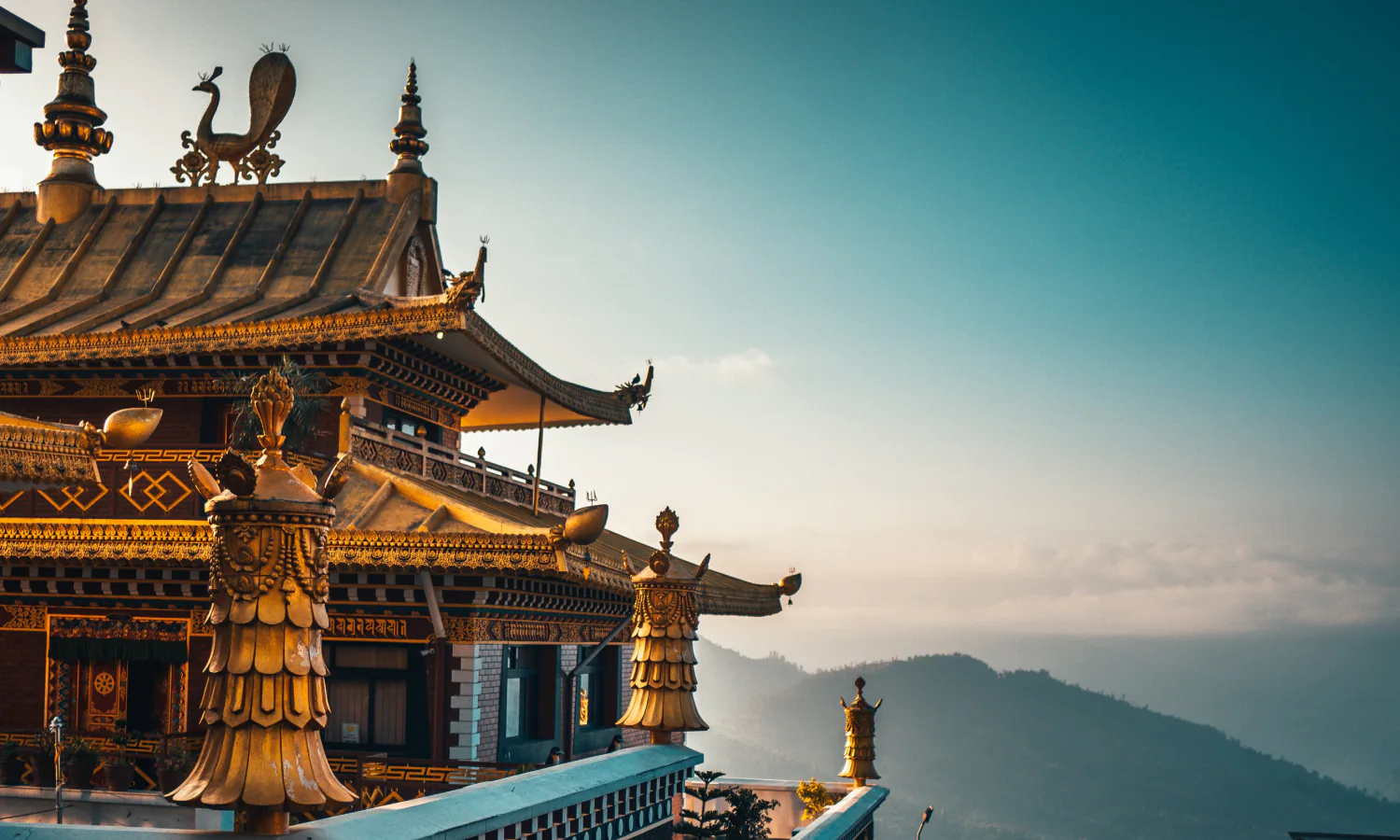
Finally, the pervasive practice of Feng Shui ensures that buildings are oriented towards the south for optimal light and positioned to attract “Qi” (positive energy), while decorative elements serve as a rich symbolic language. Vibrant colors like red (for joy and good fortune) and yellow (historically reserved for the imperial family), alongside motifs such as bats (a homonym for fu, or good fortune), were deliberately incorporated to invoke protection, prosperity, and spiritual well-being.
Traditional Chinese houses are, therefore, not just static historical relics. They are dynamic cultural narratives cast in architecture, preserving ancient ethical systems and cosmic beliefs that continue to inform how the Chinese view their family, their society, and their place in the world.