Breaking News




Popular News



Enter your email address below and subscribe to our newsletter

 Byafshena
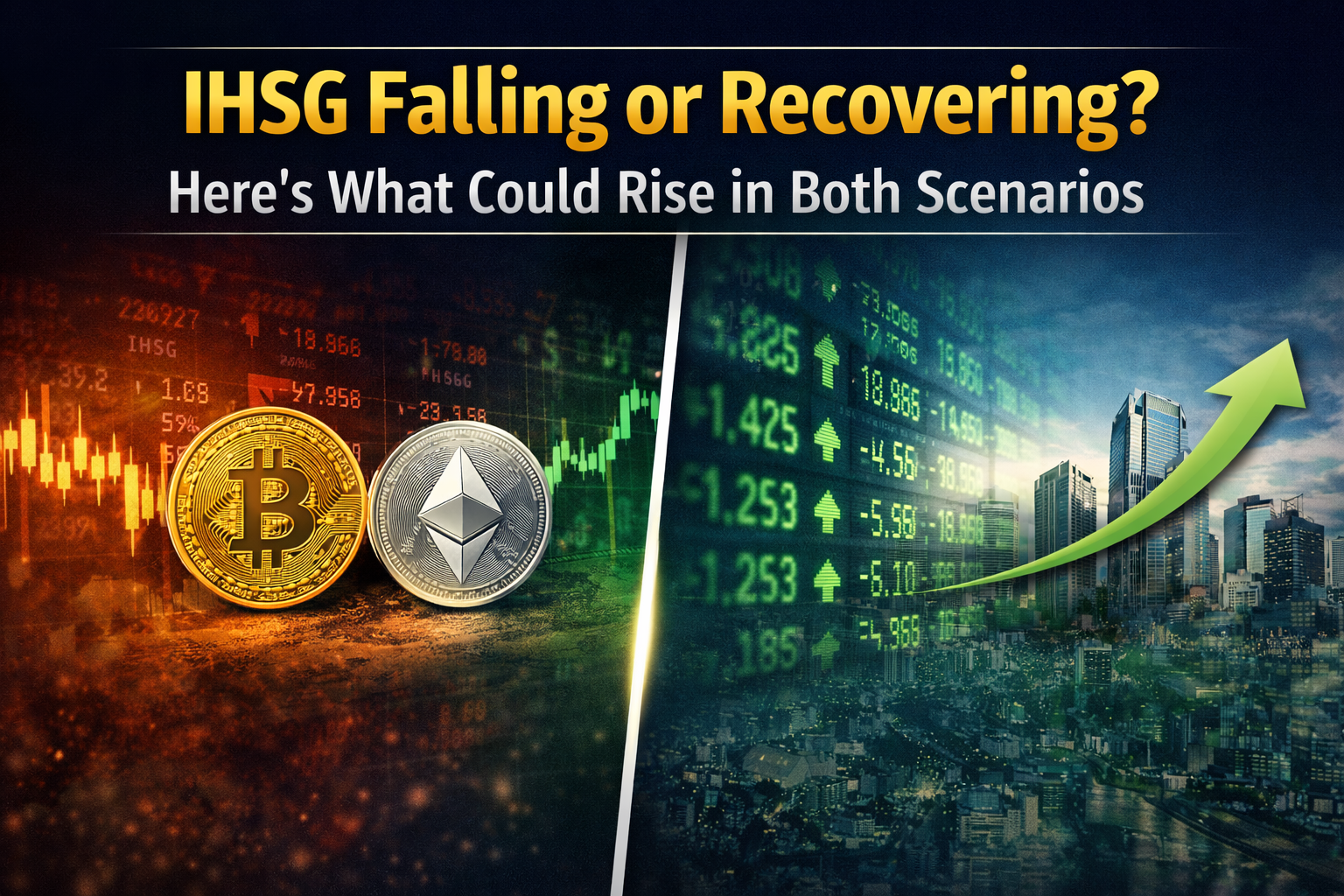
Indonesia’s benchmark stock index has entered a period of heightened volatility, raising a key question for global investors: What assets could rise if the IHSG continues to fall — and what could benefit if it recovers instead?
As market uncertainty grows, understanding both scenarios has become critical for investors seeking to manage risk while identifying potential opportunities.
If selling pressure in Indonesian equities persists, investors typically shift toward assets that offer liquidity, diversification, or perceived protection during market downturns.
Major cryptocurrencies such as Bitcoin and Ethereum often attract attention during periods of equity market stress. Their 24/7 trading structure and global accessibility make them appealing for short-term positioning when traditional markets face heavy selling.
While cryptocurrencies remain volatile, they have historically been among the first assets to react when risk sentiment begins to shift.
In addition to digital assets, investors frequently turn to commodities and defensive instruments. Gold and commodity-linked assets are commonly viewed as hedges during times of financial uncertainty, particularly when market confidence weakens.
A market recovery would signal improving investor confidence and a potential return of capital into Indonesian equities.
A stabilization or rebound in IHSG could trigger renewed interest in equities, particularly large-cap and fundamentally strong companies. Historically, recovery phases are often accompanied by increased trading volume and broader participation from institutional investors.
Improving sentiment may also encourage foreign capital inflows. International investors often re-enter emerging markets when risk conditions improve, potentially supporting further gains in equity prices.
Rather than betting on a single outcome, many investors are adopting a diversified approach — balancing exposure between high-risk, high-reward assets and more defensive holdings. This strategy allows portfolios to remain flexible regardless of whether the market continues to decline or begins to recover.
Risk management, liquidity awareness, and disciplined allocation remain key factors during volatile periods.
Whether the IHSG continues its downward trend or stages a recovery, market volatility is likely to remain elevated in the near term. Assets such as cryptocurrencies, defensive commodities, and select equities may each play a role depending on how market sentiment evolves.
Investors are advised to closely monitor global economic signals, capital flow trends, and domestic market developments before making major portfolio decisions.
This article is for informational purposes only and does not constitute financial or investment advice.