Breaking News


Popular News




Enter your email address below and subscribe to our newsletter

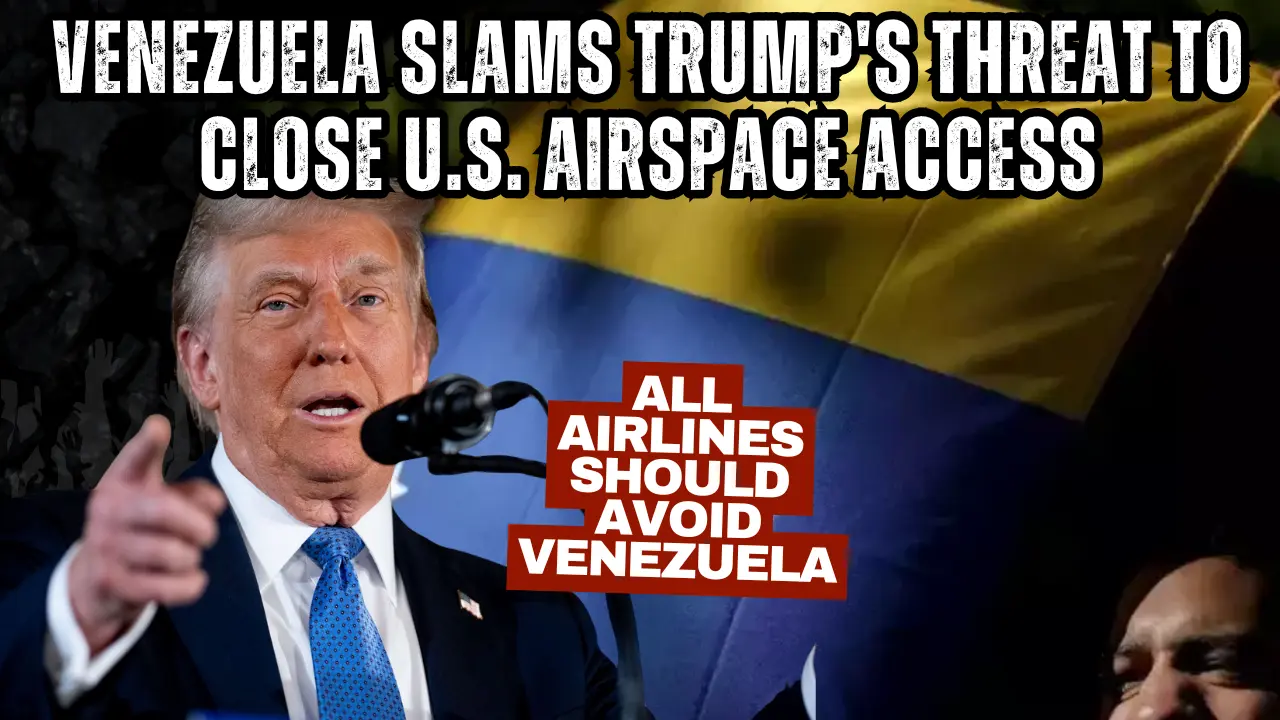
The diplomatic conflict between Washington and Caracas just erupted into a full-blown geopolitical confrontation, raising the specter of military and economic escalation. In an unprecedented move, President Donald Trump issued a sweeping threat on social media: the “entirety” of the airspace over and around Venezuela would be immediately closed to air traffic. This dramatic declaration was instantly met with fury from Caracas. Branding the move as a “colonial threat” and an “unlawful aggression,” the Venezuelan government has publicly condemned the U.S. action. This is more than a flight ban; it’s the latest, most explicit escalation in a long-running campaign to undermine the Maduro regime, risking regional instability and setting a dangerous precedent in international law.
The simmering tensions between the United States and Venezuela reached a critical boiling point over the weekend with a direct and unambiguous threat issued by President Donald Trump. Utilizing his official social media platform, Truth Social, Trump announced a drastic measure aimed squarely at Caracas: the complete closure of airspace over and surrounding Venezuela.
Trump’s post, published on Saturday (November 29, 2025), was explicitly broad, targeting not only commercial carriers but also those involved in illicit activities:
“To all airlines, pilots, drug dealers and human traffickers. Please be advised that the airspace over and around Venezuela will be closed in its entirety.”
This declaration immediately escalated the conflict beyond diplomatic sanctions into the realm of potential military or regulatory enforcement over sovereign airspace, a move with massive implications for international law and regional stability.
The response from the administration of Venezuelan President Nicolás Maduro was swift, unequivocal, and highly aggressive in its language. The Venezuelan Foreign Ministry issued a formal statement denouncing the action as an existential threat to its national autonomy.
“Venezuela rejects and condemns the colonial threat that seeks to affect the sovereignty of our airspace. This is an excessive, illegal, and unfounded aggression against the Venezuelan people,” the Ministry’s statement declared, as reported by Al Jazeera.
By labeling the threat as “colonialist” and an “unlawful aggression,” Caracas attempted to frame the U.S. action not merely as a foreign policy decision, but as an attempt to undermine Venezuela’s legitimate status as a sovereign nation, echoing historical fears of Western interference in Latin America.
Read More : Trump Ally Troy Nehls Quits Congress: The Growing GOP Retirement Trend
The U.S. administration officially framed the threatened airspace closure as a necessary measure to combat drug trafficking and human smuggling. This aligns with the U.S.’s broader declared strategy of targeting the financial and logistical networks supporting the Maduro regime, which Washington accuses of involvement in transnational crime.
This reasoning gained a measure of public support following previous U.S. actions in the region, including the deployment of a Navy aircraft carrier to the Caribbean and a series of lethal bombings targeting vessels allegedly involved in drug operations—actions that reportedly resulted in dozens of casualties. Furthermore, earlier that week, Trump had warned of an impending shift to ground-based operations in the war against Venezuelan drug trade.
However, numerous human rights observers, political analysts, and experts view the official U.S. rationale with deep skepticism. They argue that the focus on drug trafficking serves as a pretext for a more profound political goal: the unlawful and forceful removal of Nicolás Maduro from power.
The threat to close sovereign airspace is seen as a dramatic escalation designed to choke the country economically and politically, further isolating the regime and potentially provoking an international incident that could justify further intervention. The use of language like “colonialist” by Venezuela strongly reflects this belief that the U.S. is seeking to dictate Venezuela’s internal affairs and exert imperial control over its territory.
The core of Venezuela’s condemnation lies in the fundamental principles of international law, specifically the Chicago Convention (1944), which enshrines the complete and exclusive sovereignty of a state over the airspace above its territory. A unilateral threat by the U.S. to “close” this sovereign airspace, even to aircraft other than its own, is viewed by many as a clear violation of this bedrock principle.
The threat introduces a new, highly volatile element to the long-standing crisis: direct, state-level confrontation over territory.
The airspace threat must be understood as the latest move in a multi-faceted campaign by the Trump administration aimed at destabilizing the Maduro regime.
Since recognizing opposition leader Juan Guaidó as the legitimate leader of Venezuela, the U.S. has utilized extensive economic sanctions, primarily targeting Venezuela’s critical oil sector. These actions, designed to cut off the regime’s revenue streams, have crippled the country’s economy. The airspace closure threat acts as a logistical sanction, further tightening the screws of isolation.
The recent military deployment to the Caribbean, ostensibly for counter-narcotics operations, represents a shift towards aggressive enforcement. This move aligns with the administration’s stated goals to dismantle the regime’s illicit networks, but also provides a visible, coercive presence near Venezuelan territory.
President Trump’s threat to close Venezuelan airspace marks a definitive and deeply aggressive turning point in the relationship between the two nations. Venezuela’s condemnation, utilizing the emotionally charged language of “colonialism” and “illegal aggression,” encapsulates the severity of the perceived challenge to its national dignity and sovereignty.
This event forces the international community to grapple with complex questions regarding the limits of unilateral security actions, the principles of air sovereignty, and the ongoing, often blurred lines between counter-narcotics efforts and politically motivated regime change. As the two nations continue their diplomatic and rhetorical confrontation, the threat remains a powerful symbol of the heightened geopolitical volatility in the Western Hemisphere. The world watches to see if the threat will be fully enforced, and what the ultimate consequence will be for global aviation and international law.